Why Republicans Wear Red and Democrats Wear Blue
Introduction
The familiar red‑for‑Republicans and blue‑for‑Democrats image dominates today’s election coverage, yet this color coding is far from a timeless tradition. Early American politics used the patriotic trio of red, white and blue without assigning them to any party, and the symbols that later defined party identities were animal mascots, not hues.
Evolution of Party Colors
During the 19th century, the Democratic Party adopted the donkey as a badge, a nod to Andrew Jackson’s critics, while the Republican Party gained the elephant after Thomas Nast’s cartoons in the 1870s. When colors were occasionally linked to parties, the Democrats were more likely to use red, echoing the British Labour red to appeal to labor voters before the 1930s. Republicans leaned toward blue, invoking the Union army’s blue uniforms and Abraham Lincoln’s legacy. Throughout the 20th century, however, wearing red or blue did not signal party allegiance. For example, Geraldine Ferraro’s red dress in 1984 and Nancy Reagan’s “Reagan Red” shirts were personal fashion choices, not political statements.
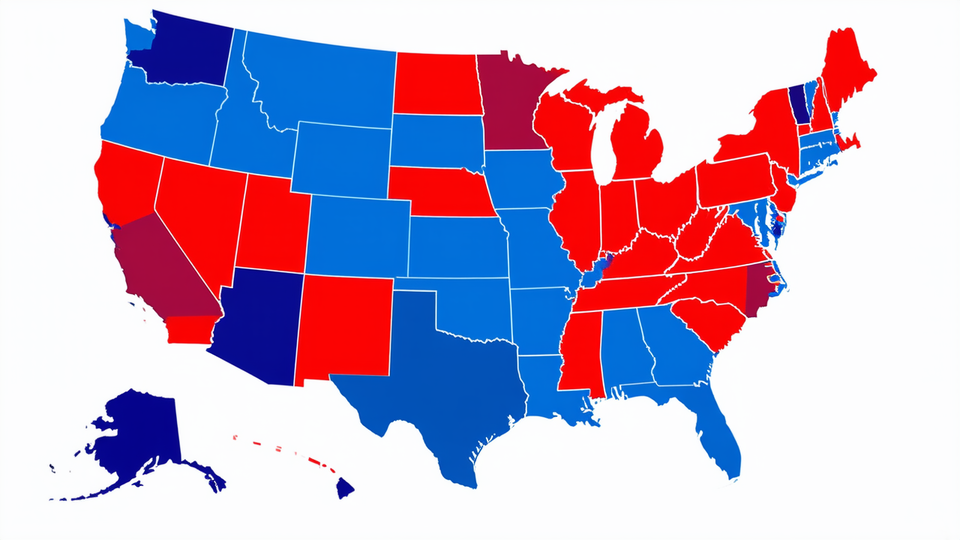
The shift accelerated in the 2000 presidential race. Television networks chose red to shade the states won by George W. Bush and blue for those won by Al Gore. The maps were broadcast repeatedly, cementing the association in the public mind. A young Illinois senator, Barack Obama, later amplified the divide in his 2004 DNC speech, urging voters to see “red” values such as small government and “blue” values such as gay‑rights as part of a broader national tapestry.
Impact on Modern Politics
Since the 2000 election, the color binary has become more than a visual aid; it influences how Americans discuss policy and identity. The Republican Party embraced red branding through initiatives like Redmap in 2010, a gerrymandering campaign that literally painted maps red to emphasize their control. By 2012, states were routinely labeled “red” or “blue,” even when voting patterns defied the label—Kamala Harris secured nearly five million votes in Texas, and Donald Trump captured 43 % of the vote in New York.
This simplification creates an “in‑group, out‑group” mentality, discouraging nuanced conversation and marginalizing minority viewpoints. The spectrum of voter beliefs is often richer than the two‑color framework suggests, and the binary can silence minority voices, overlooking the fact that people, not land, cast ballots.
Conclusion
Red and blue have proven to be powerful symbols, but they are a relatively recent construct, shaped by media choices, campaign strategies, and cultural narratives. Recognizing the origins of these colors reminds us that political identity is more complex than a simple palette, and expanding the visual language could foster a more inclusive and accurate dialogue about American democracy.