Potential Toxic Space Debris Found on Queensland Beaches
Introduction
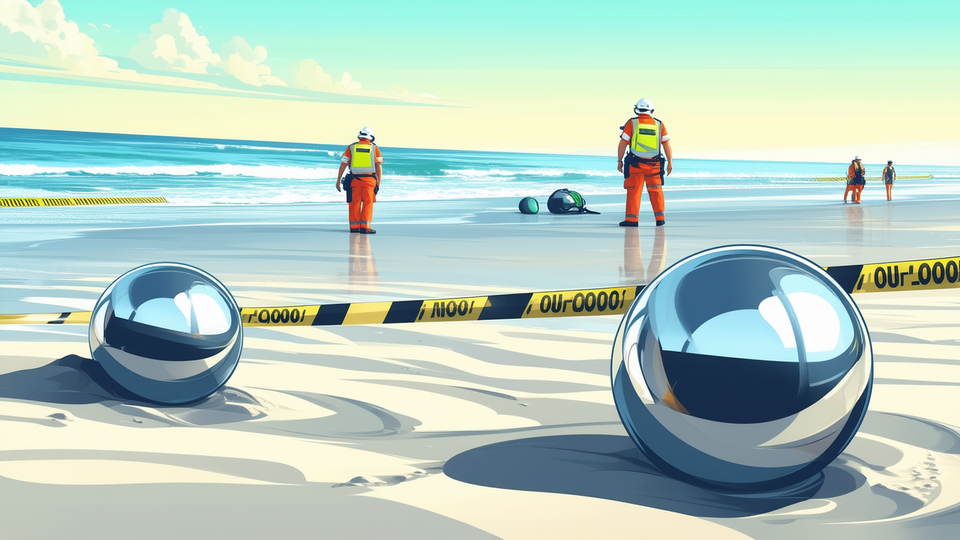
On the morning of 7 May 2026, residents of Forrest Beach, a small coastal community in Queensland, reported a series of shiny, spherical objects scattered across the sand. Local authorities quickly responded, establishing a 50‑metre exclusion zone and urging the public to avoid handling the debris. The Queensland Fire and Rescue (QFR) team, alongside partner agencies, began securing the objects, which appeared to be black‑metal spheres resembling components used in spacecraft.
Discovery and Immediate Response
Firefighters and scientists from the QFR identified at least six of the mysterious items. Each sphere was carefully placed into sealed drums and stored under police guard. Residents were instructed to stay clear of the area and to call emergency services (Triple Zero) if they encountered any suspicious material. The swift coordination between fire crews, police and emergency management helped prevent potential exposure while the investigation continued.
Authorities emphasized that the objects were “potentially hazardous,” noting that the material could be hazardous to health if mishandled. The public safety advisory highlighted the need for caution, especially given the unknown composition of the objects and the possibility of toxic residues.
Scientific Speculation About Origin
Early analysis indicated that the spheres match the appearance of titanium‑alloy fuel tanks used in satellite maneuvering systems. Such tanks often contain hydrazine, a highly volatile and carcinogenic propellant employed for precise spacecraft positioning. Hydrazine’s toxicity and flammability raise concerns about environmental contamination if residues remain on the beach.
Historical precedents support this interpretation. In 1979, fragments of the Skylab space station landed in Western Australia, and in 2022 a SpaceX Dragon trunk was recovered in New South Wales. Both cases involved aerospace hardware surviving re‑entry and reaching Earth’s surface. Experts therefore suspect that the Queensland spheres are remnants of a recent rocket launch, possibly a launch vehicle or satellite that failed to fully burn up during atmospheric re‑entry.
Public‑Health and Environmental Measures
The Australian Space Agency (ASA) has been consulted to provide technical expertise and to liaise with foreign operators. The ASA’s role includes assessing the chemical composition of the debris, evaluating any health risks, and advising on safe disposal. Current protocols involve securing the items in airtight drums, monitoring the exclusion zone, and conducting laboratory tests to detect any residual hydrazine or other hazardous substances.
Community officials have also issued clear guidance: do not touch the spheres, keep pets and children away from the beach, and report any further findings to emergency services. These measures aim to minimize the risk of chemical exposure, fire, or accidental ignition.
Conclusion
The unexpected arrival of metallic spheres on Queensland’s coastline underscores the growing intersection of space activity and public safety. While the exact launch remains unidentified, early evidence points to space debris containing hazardous materials, prompting a coordinated emergency response and ongoing scientific investigation. Residents can be reassured that authorities have contained the objects and are actively working to determine their origin, ensuring that any potential environmental or health impacts are addressed promptly.