Marblehead troops hold British at Pelham, buying Washington’s army time to flee
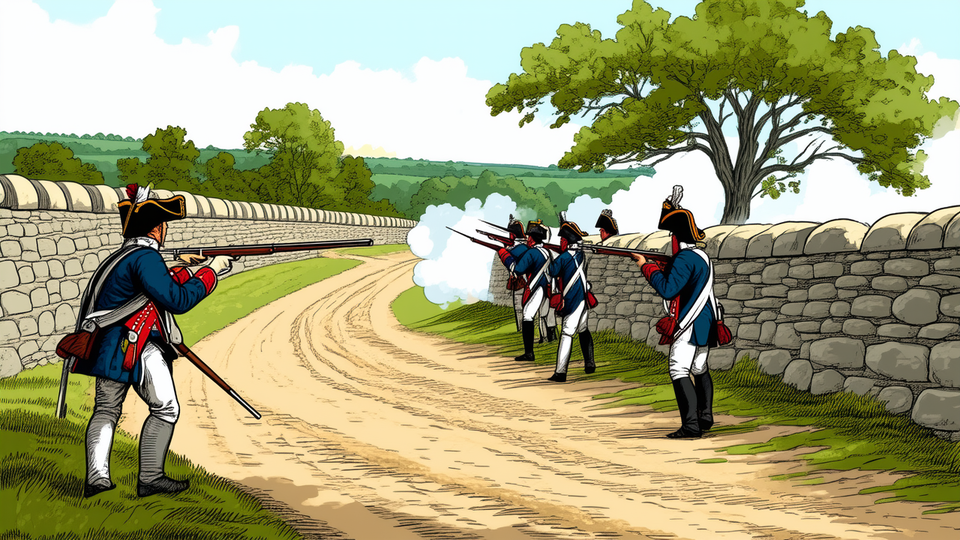
Colonel John Glover and his Marblehead regiment engaged a British and Hessian force near Pelham, New York, on October 18, 1776, buying General George Washington’s main army time to retreat northward.
The stand prevented the British from cutting off the Continental Army, a move that could have ended the Revolutionary War at an early stage. By holding the road behind stone walls, Glover’s men delayed a numerically superior enemy long enough for Washington’s troops to reach White Plains.
Historical accounts note that roughly 750 American militiamen faced about 4,000 British and Hessian soldiers. The Americans positioned themselves behind a double line of stone walls that forced the attackers into a narrow column along the road, allowing the defenders to concentrate fire despite their smaller numbers.
“The enemy gave a shout and advanced; Colonel Read’s laying under a cover of a stone wall undiscovered till they came within thirty yards, then rose up and gave them the whole charge; the enemy broke and retreated for the main body to come up,” Glover wrote of the action.
Colonel Joseph Read’s men opened fire from behind a wall and forced the first wave of the enemy to pull back. Later, Colonel William Shepard’s regiment, positioned on the opposite side of the road, kept a steady stream of fire, exchanging seventeen rounds and causing the British to retreat several times. At one point a soldier leapt over a fallen British captain to seize his hat and canteen.
The engagement lasted about ninety minutes. American casualties numbered six dead and thirteen wounded, including Shepard, who famously noted the lack of water from a bullet wound before resuming command. British losses were estimated at over two hundred killed, a figure that far exceeded the size of Glover’s force.
When the British finally halted their advance, they overestimated the American strength by more than tenfold. General Howe chose not to pursue further, allowing Washington’s army to escape and continue the fight. The battle, though a tactical loss on the field, proved decisive in preserving the revolutionary cause for another year.