Paris, May 28, 2026: France Unites to Repeal 17th‑Century Slavery Law
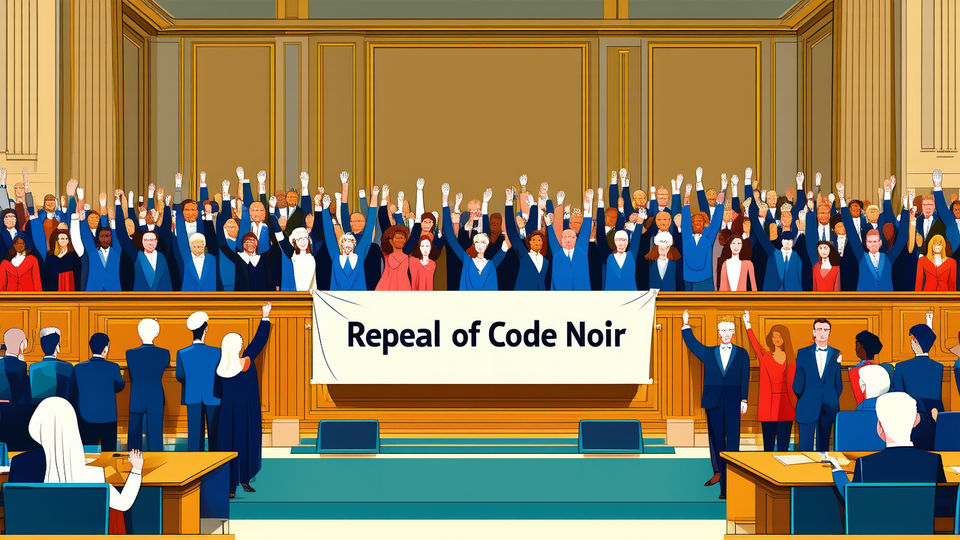
In a historic decision that reverberated across France’s overseas departments and beyond, the National Assembly in Paris voted 254‑0 to repeal the Code Noir, the 1685 decree that formally defined enslaved individuals as movable property. The unanimous vote ended a quiet chapter of 240 years in which the law persisted on the books after slavery was abolished in 1848.
The repeal was hailed by lawmakers and activists who point to the law’s brutal statutes—allowing masters to beat, sell, and even murder enslaved people—as a symbolic clearing of a legal stain that had lingered in France’s legislative archives. Steevy Gustave, a lawmaker whose ancestors were enslaved on Martinique, called the move “necessary,” adding that no single vote could repair centuries of shattered lives but that the act could restore humanity to descendants seeking acknowledgment of their history.
Key figures in the discussion included Max Mathiasin from Guadeloupe, who had never known the Code Noir existed until he discovered copies in his family library. He said the vote “restores our ancestors, restores our humanity” and that it is a necessary step toward living up to the values of liberty, equality, and fraternity. Critics, however, note that the law’s repeal is largely symbolic, as many in France’s overseas territories still experience disparities in education, employment, and health compared with mainland France.
President Emmanuel Macron announced the repeal the week prior, stating that the law “should never have survived the abolition of slavery.” He did not issue a formal apology but emphasized truth‑telling, education, and historical work as first steps toward reparations—a stance many see as a sign that France continues to grapple with reparative justice.
The repeal also triggers debate about the deeper reality of French colonial governance. Several politicians argue that France’s designating of Guadeloupe, Martinique, French Guiana, and Réunion as overseas departments has not fully integrated them into the Republic; instead, a “colonial exception” persists, according to some scholars. These discussions highlight that the law’s removal, while symbolically significant, may not immediately translate into concrete policy or financial reparations.
Nevertheless, the unanimous vote was a milestone for France as it grapples with its colonial legacy. The French parliament’s action signals an official acknowledgement of the Code Noir’s historical wrongs and may lay the groundwork for future dialogue on reparative measures, including education reforms and potential monetary compensation.