May 29, 2026: U.S. General Francis Donovan Meets Cuban Commanders at Guantanamo Bay Perimeter
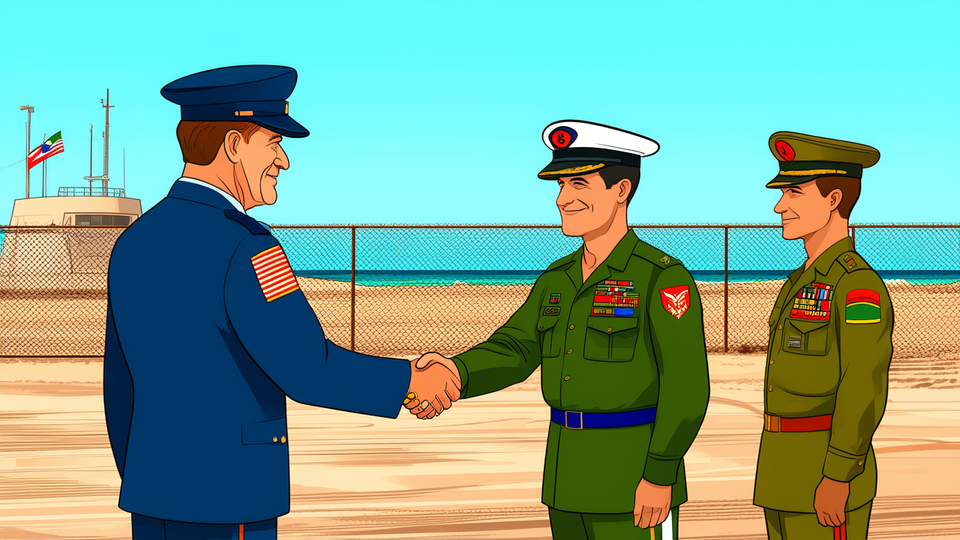
May 29, 2026: U.S. General Francis Donovan Meets Cuban Commanders at Guantanamo Bay Perimeter
On the morning of May 29, 2026, General Francis L. Donovan, the commander of U.S. Southern Command, crossed the fence outside the U.S. Naval Station in Guantanamo Bay to meet a delegation of senior Cuban military officials. The brief encounter, described by U.S. officials as a “brief exchange on operational security matters,” was the first time a head of Southern Command had visited Cuba in many years.
The Cuban delegation included General Roberto Legra Sotolongo, first deputy minister of the Supreme Military Staff. The conversation focused on safety concerns for U.S. personnel and the overall operational readiness of both sides. A U.S. Southern Command statement posted on X noted that the talk also touched on the welfare of service members and their families.
President Donald Trump’s administration has been increasing pressure on Cuba, citing a “failed state” in the island’s leadership. The meeting coincided with a broader campaign that saw the U.S. blockade of Cuban fuel supplies, the indictment of former Cuban leader Raul Castro for charges linked to the 1996 downing of a civilian aircraft, and a high‑profile raid on Venezuelan President Nicolas Maduro earlier that year.
In the months leading up to the meeting, top U.S. aides, including Secretary of State Marco Rubio and CIA Director John Ratcliffe, had also engaged with Cuban officials in an attempt to ease tensions. The Guantanamo meeting, however, marked a different tone, implying a cautious recalibration of military posture on that frontier.
Cuban Foreign Minister Bruno Rodriguez warned that any U.S. military move could trigger a “bloodbath,” with thousands of casualties on both sides. He emphasized that dialogue, however limited, was preferable to conflict. Deployments of U.S. forces around the base continue, as the Pentagon announced in late May that a new unit of 1,300 sailors and Marines would replace the 22nd Marine Expeditionary Unit at Guantanamo, underscoring the strategic importance of the installation.
The meeting’s limited duration and focus on operational details do not obscure its underlying significance. For U.S. officials, it signaled that operational logistics and base security are a priority even amid a broader push for regime change. For Cuban officials, it was an acknowledgment of their security concerns and a reassurance of a temp suggestive of peace.
Historically, the U.S. has maintained a military presence at Guantanamo since 1898, despite tenacious friction with Cuban leadership. The camaraderie that has developed over decades of co‑existence is woven through fear, suspicion, but also shared interests in maintaining stability in the Caribbean.
Although the meeting is short, its broader context positions it as a pivot point that could shape U.S. strategy in Latin America. The event is a reminder that military diplomacy is not only about troop movements but also about candid conversations in front of a concrete–soft fence that divides two very different worlds.
Whether this encounter will herald a new era of cooperation or simply serve as a tactical forkbeater remains to be seen. It does, however, underscore the delicate balance the U.S. must maintain between protecting its interests and respecting Cuban sovereignty.