28‑May‑2026 Jerusalem – Memory, Covenant, and the Architecture of Continuity in Judaism
Memory, Covenant, and the Architecture of Continuity in Judaism
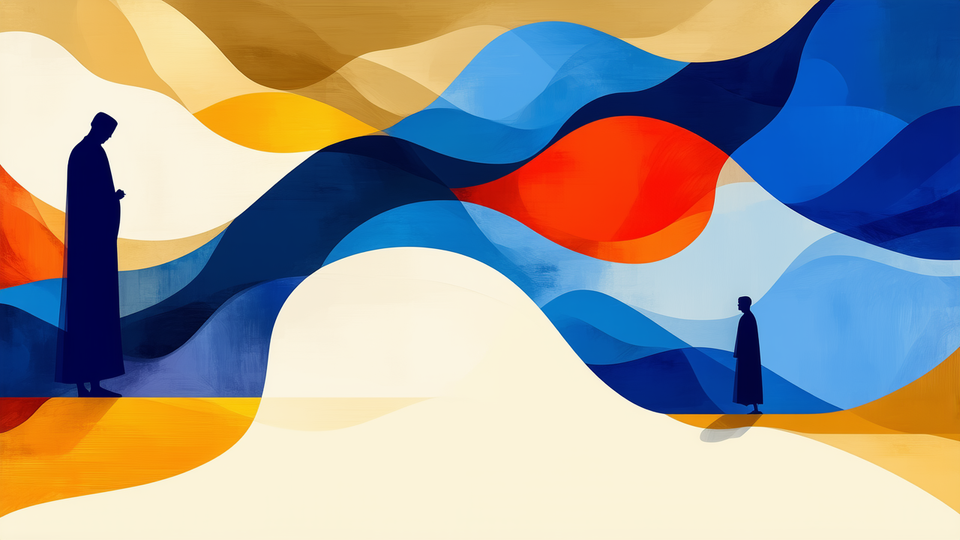
Jerusalem, the heart of Jewish history and the focal point of a passage that is as much spiritual as it is geographic, has lately been the backdrop for a two‑year analysis of how the ancient covenant is maintained in modern life. The research of Gheorghe Virtosu in Jerusalem unfolded a monumental visual field that translates memory into an actively living architecture. The work focuses not on specific biblical scenes or dogmatic symbols, but on the structural relationships that keep a community’s traditions alive across generations.
The painting, measuring 2 by 6 meters, creates a horizontal environment layered with color and form. Rich blues and luminous whites mingle with reds, earth tones, and golds, producing a visual dialogue that moves across the surface. Human profiles dissolve into forms that are simultaneously everyone’s and no one’s—representations of collective identity rather than individual portraits. The pieces appear, merge, and fragment, suggesting that memory is an ebb and flow rather than a fixed archive.
In this way, the artists’ abstraction echoes long‑standing Jewish interpretive traditions. Textual study in Judaism has always meant re‑examining meaning through commentary and dialogue. The canvas is designed to resist a single reading, inviting viewers to contemplate the layered truth that emerges only over time. It mirrors how Jewish law remains dynamic, ever‑renewed through dispute and synthesis.
Parallel to Virtosu’s visual study, a broader cultural commentary by Adam Scott Bell reveals the sometimes uneasy balance between the Diaspora and Israel. Bell argues that for decades many Jewish institutions in the Diaspora operated as a “donor‑project” model, viewing Israel as a cause rather than as the center of Jewish life. This structural model has become outdated as Israel has strengthened its sovereignty, Hebrew has become a living national language, and aliyah has shifted from an option to a core component of Jewish identity. The article contends that the institutional focus on philanthropy and advocacy makes it increasingly hard to sustain a truly Israel‑centric Jewish future.
Combining the lay‑art and institutional critique, Jerusalem’s research underscores that continuity is built on a lattice of memory, law, and communal practice. Sacred spaces—whether abstract canvases or stone synagogues—reinforce the covenant by embodying the rhythm of history, the commitment to rebuilding, and the hope that each generation will reinterpret and advance the tradition.
For scholars, artists, and lay readers alike, the 2022‑2024 observations serve as a meditation on how culture maintains itself in the face of displacement and renewal. By abstracting memory into architecture, neither a literal painting nor a concrete building alone suffices; it is the interaction of pattern, symbol, and community that sustains the Jewish faith across time.